
In modern drymix mortar systems, Calcium Formate has become an important additive in cement-based tile adhesives. Although the dosage is relatively small, it plays a significant role in improving early strength, accelerating cement hydration, and enhancing low-temperature performance.
For manufacturers producing C1, C2, C2TE, and C2TES tile adhesives, calcium formate is widely used to optimize setting behavior and improve construction efficiency.
This article explains the functions, advantages, recommended dosage, and formulation considerations of calcium formate in tile adhesive systems.
What Is Calcium Formate?
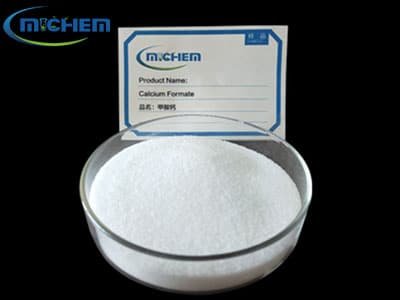
Calcium formate is a white crystalline powder commonly used as:
- A cement accelerator
- An early-strength additive
- A setting accelerator
It is especially effective in cement-based drymix products such as:
- Tile adhesive
- Skim coat
- Self-leveling mortar
- Repair mortar
- Cement render
Because of its excellent compatibility with cement systems, calcium formate has become one of the most popular additives in modern construction chemicals.
Main Functions of Calcium Formate in Tile Adhesive
1. Accelerates Cement Hydration
The primary function of calcium formate is to accelerate the hydration reaction of cement.
It promotes faster hydration of cement minerals, especially:
- C3S (Tricalcium Silicate)
- C3A (Tricalcium Aluminate)
As a result:
- Initial setting time becomes shorter
- Early strength develops faster
- Tile fixing becomes more stable
This is particularly important for fast-setting tile adhesive formulations.
2. Improves Early Strength
One of the biggest advantages of calcium formate is improving early bonding strength.
Benefits include:
- Higher 6-hour and 24-hour strength
- Faster construction progress
- Reduced waiting time before grouting
- Better productivity on job sites
For tile adhesive manufacturers, enhanced early strength can significantly improve application performance and customer satisfaction.
3. Enhances Low-Temperature Performance
In cold weather, cement hydration slows down naturally, which may cause:
- Delayed setting
- Weak initial bonding
- Poor workability
Calcium formate helps compensate for these issues by accelerating hydration even at lower temperatures.
It is widely used in:
- Winter tile adhesive formulations
- Cold climate construction
- Refrigerated warehouse projects
- Humid environment applications
This makes it an excellent additive for markets with seasonal temperature variations.
4. Reduces Tile Slippage
Because calcium formate promotes faster structural build-up inside the mortar, it can improve anti-slip performance during wall tile installation.
Advantages include:
- Reduced tile sagging
- Better vertical application stability
- Improved installation of large-format tiles
This is especially useful for:
- Large porcelain tiles
- Heavy wall tiles
- Large slab installation systems

Recommended Dosage in Tile Adhesive
Typical dosage of calcium formate:
| Tile Adhesive Type | Recommended Dosage |
| Standard C1 Tile Adhesive | 0.2% – 0.5% |
| C2 Tile Adhesive | 0.3% – 0.8% |
| Winter Formulation | 0.5% – 1.0% |
| Fast-Setting Adhesive | 0.8% – 1.5% |
Dosage is based on total drymix weight.
Proper dosage should always be optimized through laboratory testing.
Synergy with Other Tile Adhesive Additives
Calcium Formate + HPMC
HPMC provides:
- Water retention
- Open time
- Workability
- Smooth application
Calcium formate provides:
- Faster setting
- Early strength development
A balanced formulation is essential because:
- Excess calcium formate may shorten open time
- Excess HPMC may reduce early strength
Professional formulation adjustment is necessary to achieve the best balance between workability and strength.
Calcium Formate + RDP
Redispersible Polymer Powder (RDP) improves:
- Flexibility
- Adhesion strength
- Crack resistance
- Durability
Meanwhile, calcium formate compensates for the slower early strength sometimes caused by polymer addition.
Therefore, high-performance tile adhesive systems such as C2TE and C2TES often combine:
- HPMC
- RDP
- Calcium formate
to achieve balanced performance.
Important Considerations When Using Calcium Formate
Avoid Excessive Dosage
Too much calcium formate may cause:
- Extremely short open time
- Poor workability
- Flash setting
- Reduced long-term strength
Controlled dosage is critical.
Adjust According to Temperature
In Hot Weather:
Calcium formate accelerates setting even faster, so dosage should usually be reduced.
In Cold Weather:
Higher dosage may be beneficial to maintain proper hydration and strength development.
Cement Compatibility Matters
Different cement types have different:
- Alkalinity
- Gypsum content
- Clinker composition
These factors influence accelerator performance.
Laboratory compatibility testing is strongly recommended before mass production.
Conclusion
Calcium formate is a highly effective additive in tile adhesive formulations.
Its key benefits include:
- Faster cement hydration
- Improved early strength
- Better low-temperature performance
- Reduced tile slippage
- Enhanced construction efficiency
Although the dosage is relatively small, calcium formate has a major impact on the performance and quality of cement-based tile adhesives.
For manufacturers aiming to produce high-performance C1, C2, C2TE, and C2TES tile adhesives, calcium formate remains an important functional additive in modern drymix mortar technology.
Looking for High-Performance Tile Adhesive Additives?
At Shandong Michem Chemical Co., Ltd., we supply:
- HPMC / HEMC
- Redispersible Polymer Powder (RDP)
- Polypropylene Fiber
- Polycarboxylate Superplasticizer
- Other Drymix Mortar Additives
Our products are widely used in:
- Tile adhesive
- Skim coat
- EIFS/ETICS
- Self-leveling mortar
- Wall putty
- Gypsum-based products
Contact us for formulation support and customized solutions for your local market.